skill · curated · project-management · ai-agents · Jun 19, 2026 · 3 min read
CCPM: Wiring GitHub Issues to Parallel Agent Worktrees
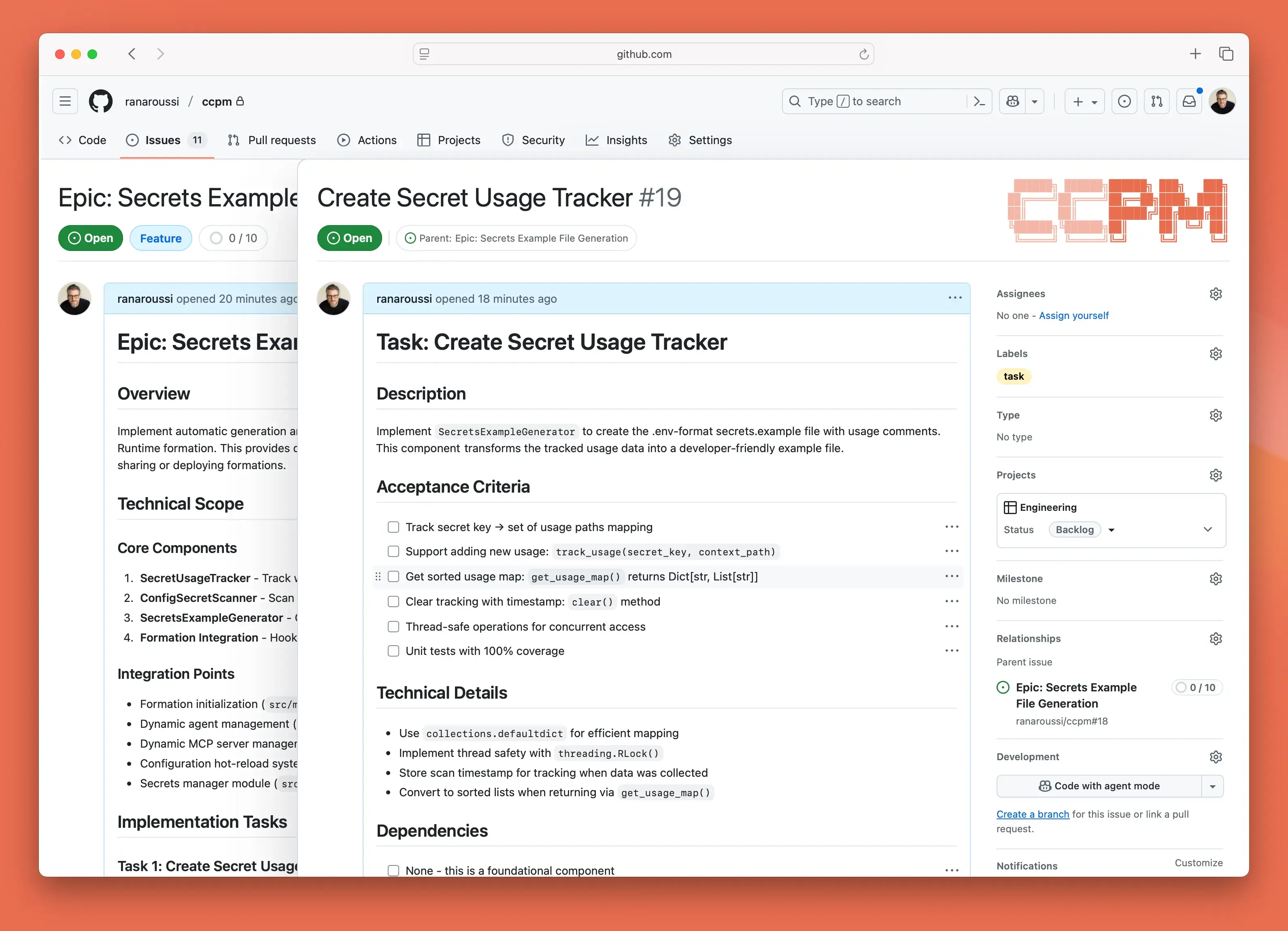
If your AI coding sessions feel like having a contractor who loses the blueprints between every visit, CCPM is the filing cabinet. It is a project management skill system that takes a product requirements document, decomposes it into epics and tasks, syncs those to GitHub Issues, and then lets multiple coding agents work in parallel — each in its own Git worktree, each commit traceable back to a specific acceptance criterion.
What it actually does
The workflow is: you describe what you want to build, CCPM writes a PRD with you, breaks it into an epic with numbered tasks, and syncs those tasks to GitHub Issues. From there you tell the agent "start working on issue 3" and it checks out a new Git worktree for that task, does the work, commits, and closes the issue. Tasks marked parallel: true can run in separate agent sessions simultaneously — frontend in one terminal, backend in another, tests in a third — with no merge conflicts because each session has its own branch and directory.
The source of truth is GitHub Issues, not conversation history. That is the fix for context loss: an agent that wakes up in a new session can read the issue tracker and know exactly where things stand instead of relying on whatever survived the context window.
When it shines
Solo freelancers building medium-complexity features across multiple sessions will feel this most. The standup command ("what's blocked?") gives you a status snapshot without scrolling through a conversation graveyard. Ran Aroussi, the author, reports it cut internal shipping time roughly in half — a number worth stress-testing on your own work before believing, but directionally plausible given how much time gets wasted on agent re-orientation.
It also handles the spec-drift problem: because tasks are written before code starts, agents execute against acceptance criteria rather than vibes. The commit history ends up cleaner too — each commit links to an issue, so code review actually tells a story.
The real caveats
The dependency chain is longer than it looks: Git, the GitHub CLI authenticated, an active GitHub repository, and ideally the gh-sub-issue extension for proper parent-child issue hierarchy. Without it, CCPM falls back to task lists inside issues — works, but loses the visual structure. None are hard to set up, but if you hit a snag on a Sunday afternoon the error messages will not be your friend.
The bigger catch: sync between local and GitHub is explicit, not live. You invoke the skill to push state to GitHub. That is fine for solo work where you control the rhythm, but in a team it means everyone has to remember when to sync — and someone will forget. This is a tool built for an individual agent orchestrator, not a drop-in for a team already living in GitHub Projects or Linear.
And if you are working on a small, one-session feature, this is overkill. The scaffolding (PRD to epic to issues to worktrees) pays off over days and multiple sessions. For a two-hour task, just prompt.
Where to find it
Built by Ran Aroussi and the Automaze team. CCPM is a standard Agent Skill — point your harness at the skill/ccpm/ directory and you are set. It works with Claude Code, Cursor, OpenCode, Amp, and Factory.
# Clone the repo, then symlink the skill into your project (Claude Code)
git clone https://github.com/automazeio/ccpm.git
ln -s /path/to/ccpm/skill/ccpm .claude/skills/ccpm
Full install notes and the source: github.com/automazeio/ccpm.