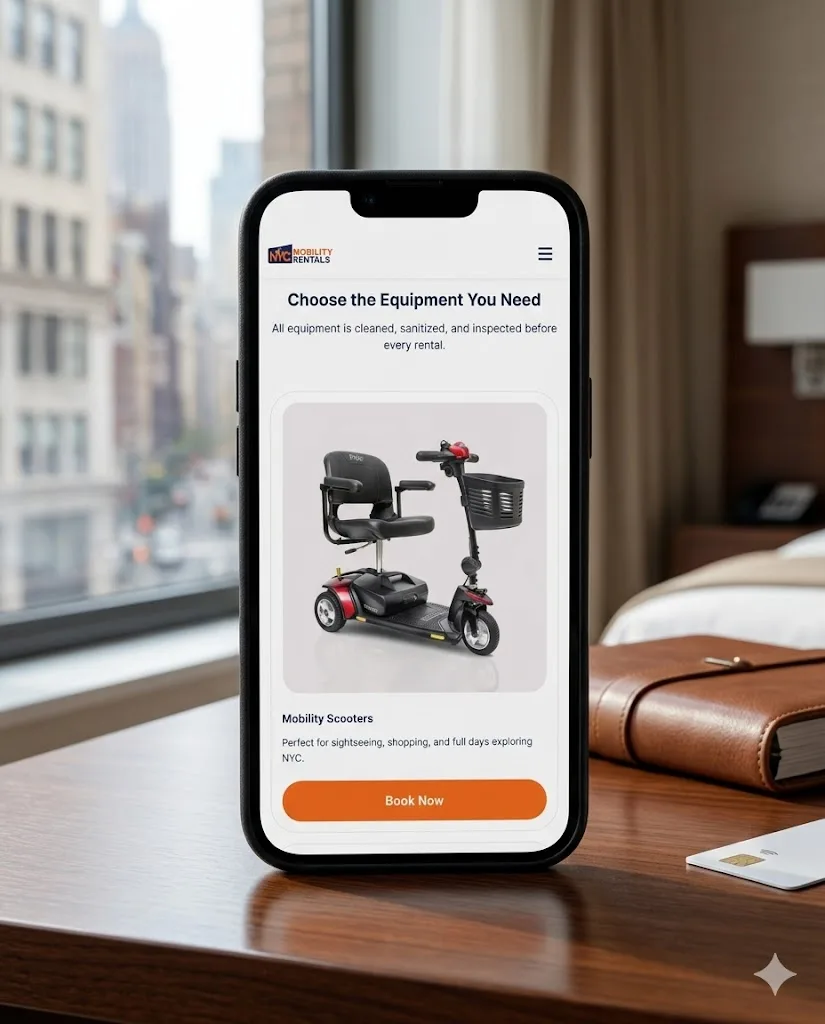
A New York mobility-rental service — wheelchairs, scooters, patient lifts — delivered same-day to hotels, homes and Airbnbs. There's nowhere to walk in, so the site carries the whole sale: browse, pick dates, book, delivered.
The problem
It's 9pm and someone's mother lands in New York tomorrow — she needs a wheelchair delivered to the hotel by noon. They find the site, and it says 'fill out this form and we'll get back to you.' Get back to them when? By morning they've already booked with whoever actually let them book. For a delivery-only business the website isn't a brochure — it's the whole shop, and a form is a shop with the lights off. Any business that sells on trust and speed — rentals, home services, anything delivered or by appointment — lives or dies in that exact moment.
The approach
I built an actual storefront, not a brochure. A category catalog — scooters, manual and power chairs, patient lifters, lift chairs, walkers — wired to a real rental booking flow with date-based availability, so a customer picks equipment and dates and books in minutes. A big phone number stays put for the callers who won't self-serve, and the trust signals — 5.0 rating, 260+ reviews, 'cleaned, sanitized, inspected' — sit exactly where an anxious first-timer looks.
The calls I made
Every real decision costs something. Here's what I traded, and why it was worth it.
A real booking engine, not a quote-request form.
WhyDelivery-only means the site is the sale. A form that ends in 'we'll get back to you' loses the customer who needs it tomorrow.
Trade-offFar more to build, and a live catalog to keep current — but it turns the site into a 24/7 storefront instead of an inbox someone has to work.
Lead with reviews and hygiene, not the catalog.
WhyWhen a stranger is delivering medical equipment to your door, trust is the conversion — you earn it before you ask for the booking.
Trade-offPrime hero space spent on proof instead of product — worth it for a first-time, high-anxiety buyer.
Keep a prominent phone number beside the online flow.
WhyCaregivers under pressure often want a human. Forcing everyone through self-serve would cost the exact customers who convert best by phone.
Trade-offSplits the funnel two ways instead of one clean path — but it meets people where they actually are.
The result
The site became a real 24/7 storefront: browse the catalog, pick your dates, book, delivered — no phone tag, no 'we'll get back to you.' The stressed caregiver at 9pm gets exactly what they need, and the owner spends the day delivering equipment instead of answering the same three questions over email. The website does the selling so the business can do the work.