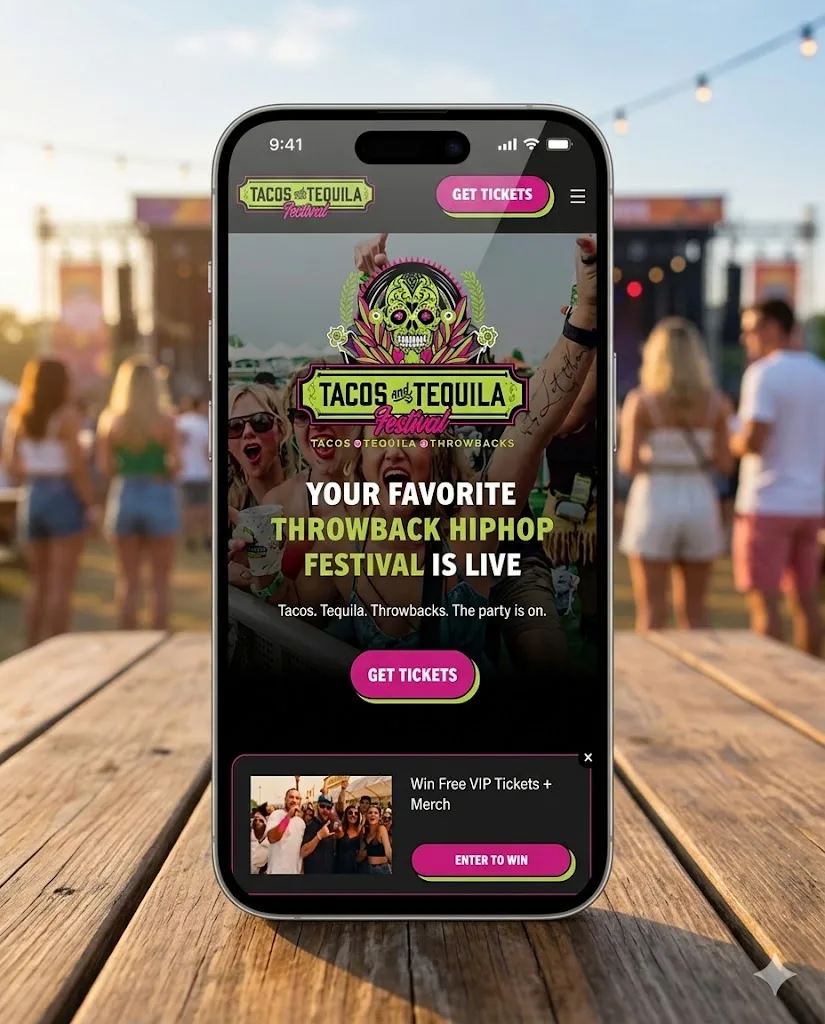
A throwback hip-hop festival that rolls into ten cities across the US and Canada. Every stop has to feel like its own event — but it all runs off a single template that spins up a new city in an afternoon.
The problem
Picture the promoter three weeks out from a ten-city tour. Tickets drop in Cleveland on Saturday, the Vegas venue just changed, and the only way to fix the site is to open a page builder and hand-edit — one city at a time. Miss a detail and a fan lands on the wrong date. Push a change an hour late and you've burned on-sale hours you can't get back. That's not a website problem, it's a 'ten plates spinning, one pair of hands' problem — the exact wall every touring, multi-location, or franchise business slams into the moment it tries to scale past the first location.
The approach
So I stopped thinking about a website and built a machine. One WordPress + WooCommerce template drives every city through a /market/{city} route — dates, venue, lineup and the Tixr on-sale are data, not markup. Spinning up Buffalo or Vegas is filling in a form, not opening a code editor. The site has exactly one job: grab attention, capture the email, and hand off cleanly to Tixr for checkout.
The calls I made
Every real decision costs something. Here's what I traded, and why it was worth it.
Offload checkout to Tixr instead of selling on WordPress.
WhyTixr is purpose-built for high-pressure ticket on-sales — queueing, fraud, scale — and it means no card data ever touches the site.
Trade-offI give up pixel control of the purchase step and live inside Tixr's flow. For live events, proven reliability beats bespoke every time.
Build the city page as a template on day one — not the first city as a one-off.
WhyTen markets were coming. Templating the first turns every future city into an afternoon instead of a sprint.
Trade-offMore architecture upfront before anything shipped — but it had paid for itself by the third city.
Put email capture ahead of the hard sell.
WhyA festival's most valuable asset is the list it can hit the second tickets drop. Own the audience before the on-sale, not after.
Trade-offThe hero leads with a signup, not a buy button — a slower first impression traded for a warm list at launch.
The result
When on-sale day hit, the lineup pages soaked up launch-day traffic without blinking, and every city was live, on-brand and correct — because none of it was hand-built under pressure at midnight. Now the promoter adds a market by filling in a form and the machine does the rest. One person, ten cities, zero fire drills. That's what a system buys you that a website never will.